Showing posts with label Marquis. Show all posts

Wednesday, May 8, 2019

May Survey

Here is what the Newman Rd field looked like this week.  The UW-Extension wheat report said that wheat in Southern Wisconsin is two weeks behind where it was last year.  Last year was also a late year, so I guess that's where climate conditions may be headed in my part of the world.  Cold, late, wet springs.  I feel bad that these conditions coincided with the first major planting of Wisconsin No 2 wheat in 80 years.  All that precious seed killed by these awful growing conditions!  But enough survived for the project to continue.

The latest climate summary from NOAA just announced that the last 12 months were the wettest on record in the US.

This is the Haynes Bluestem planting.  There is a slight washout from spring rains but otherwise it looks good.

Here is the Marquis planting.  Coming up on schedule.

The Vavilov (left) and Wisconsin No. 2.  There is no longer any denying it--the winter wheat planting was heavily damaged.  Based on the patterns and extensive washout, I believe that 90% of the damage was caused by the severe heavy rains in September, October, and November of last year.  It could be that some of it was winter-kill, but I really think most of it was rain-kill.  A combination of the saturated conditions, and the attendant cloudy cold conditions (which severely limited growth before winter set it), really doomed this planting.  I will at least be able to get back the precious seed that I planted, and I expect at least a few bushels to sell.  But not nearly what I was hoping for!

A healthy section of the Wisconsin No. 2.

Here is what April looked like in my back yard.  Rain, wet, and cold.  It's now the second week of May and we're still dealing with highs in the low 40's with rain and overcast conditions.

Tuesday, April 9, 2019

Newman Rd Spring Wheat planting

April 9 turned out to be planting day for spring wheat on the Newman Rd field.  I only planted Marquis as market wheat.  The other plantings were test plots for growing out seed.  As I've come to expect, waiting for good planting conditions is sketchy.  We had a reasonable drying trend, but then it rained more on Saturday than I had hoped.  Sunday was not very sunny, but then Monday the sun came out.  By Wednesday there was snow and rain in the forecast.  More rain and cold after that, for at least ten days.  Ergo, plant on Tuesday, or wait another two weeks.

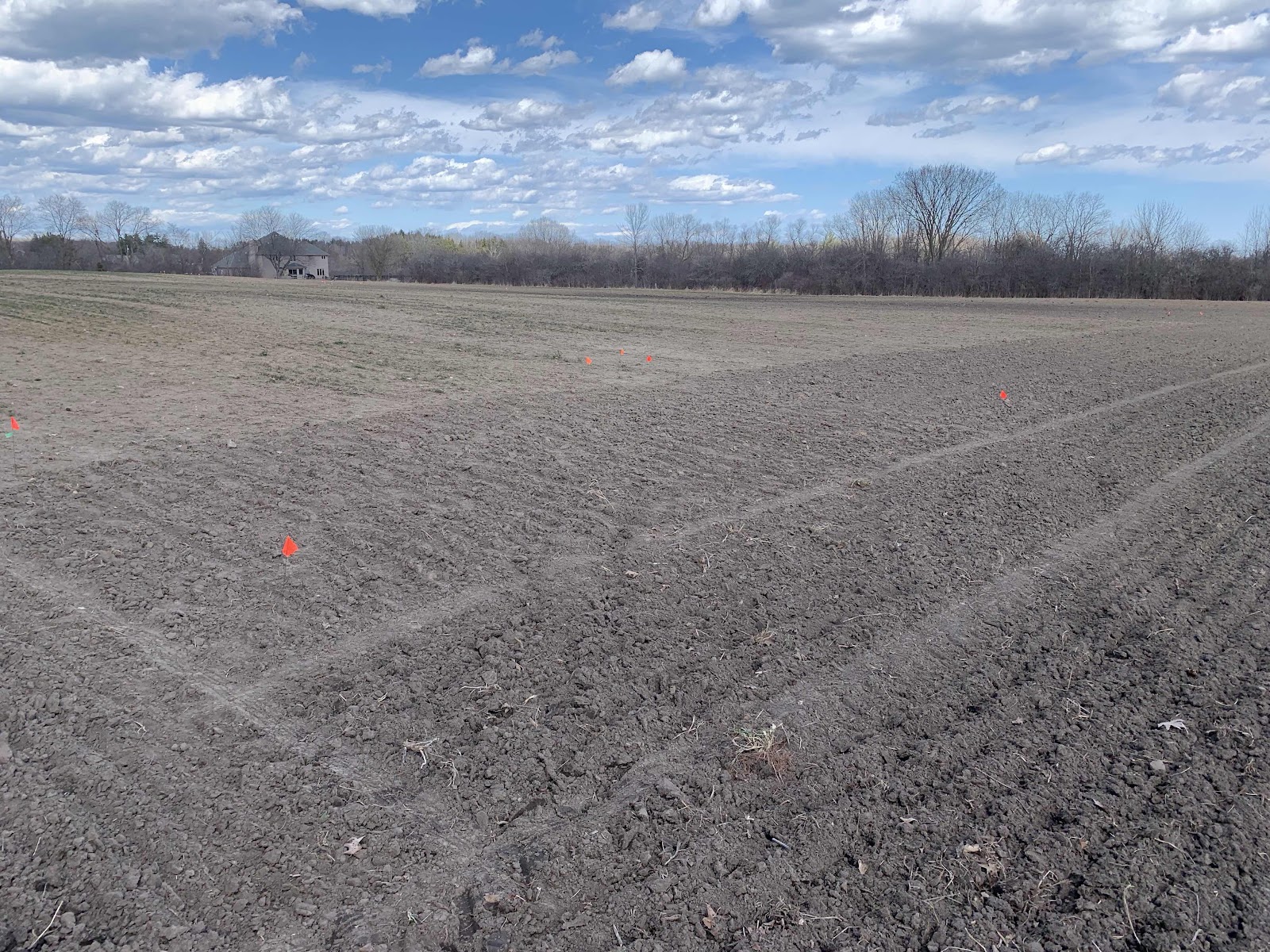
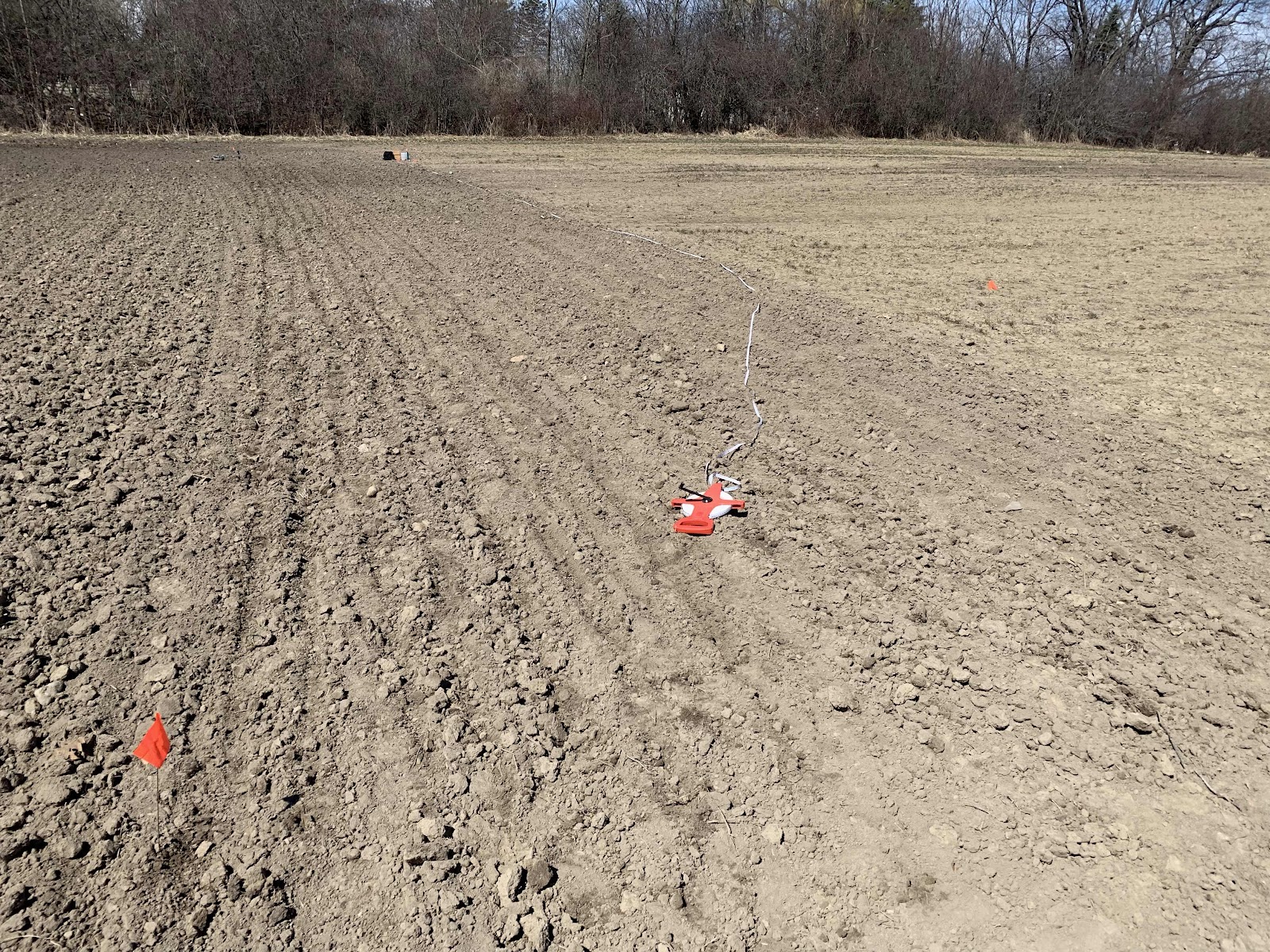
Here are the two test plots, at the South end of the winter wheat planting.  In the foreground is Wisconsin Wonder oats (Wisconsin Pedigree No 1), measuring 27.5' x 15'.  To the right and further back is the strip of Haynes Bluestem, now in it's fourth year of growing out.  That plot is 102' x 15', and it has 2013 grams of seed in it (126 lbs/acre).  This was all done with the Earthway.  I could have used the big drill on the 330 to plant the bluestem, but it would require a lot of messing around with the vacuum cleaner and still using the Earthway to fill in at the ends.  I have found that the van brunt drill is not that great when it gets down to the last few seeds--the seeding rate plummets.  So just running the earthway back and forth for 25 minutes is really the best option.

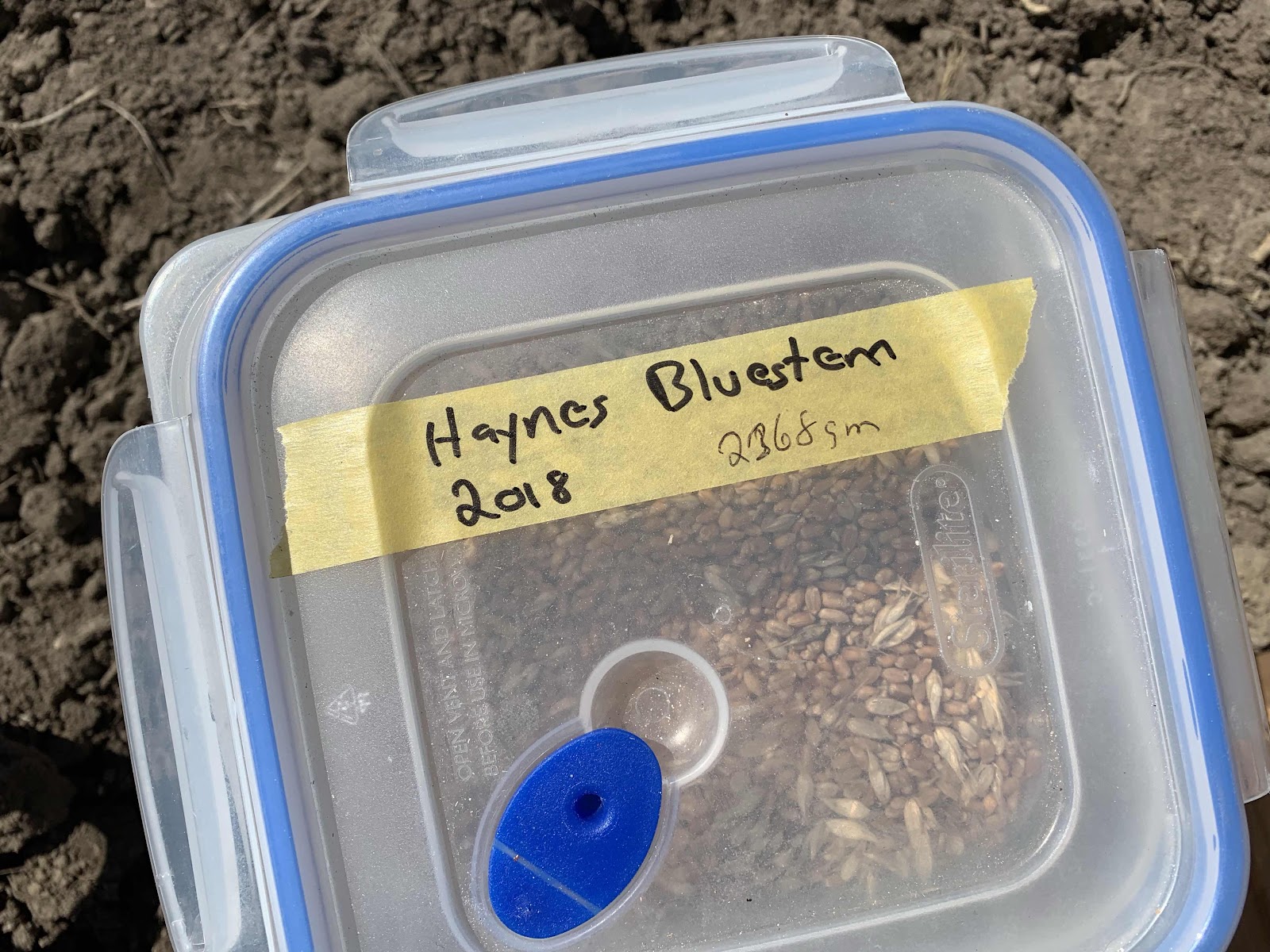
Last year I planted 115 grams of Haynes Bluestem and harvested 2368 grams, almost exactly 20:1.  I hope we can do as well out here--the soil is not quite so good as in my garden.  But 20:1 would yield 80 lbs, which would be pretty nice!  Enough to plant 1/2 acre in 2020.

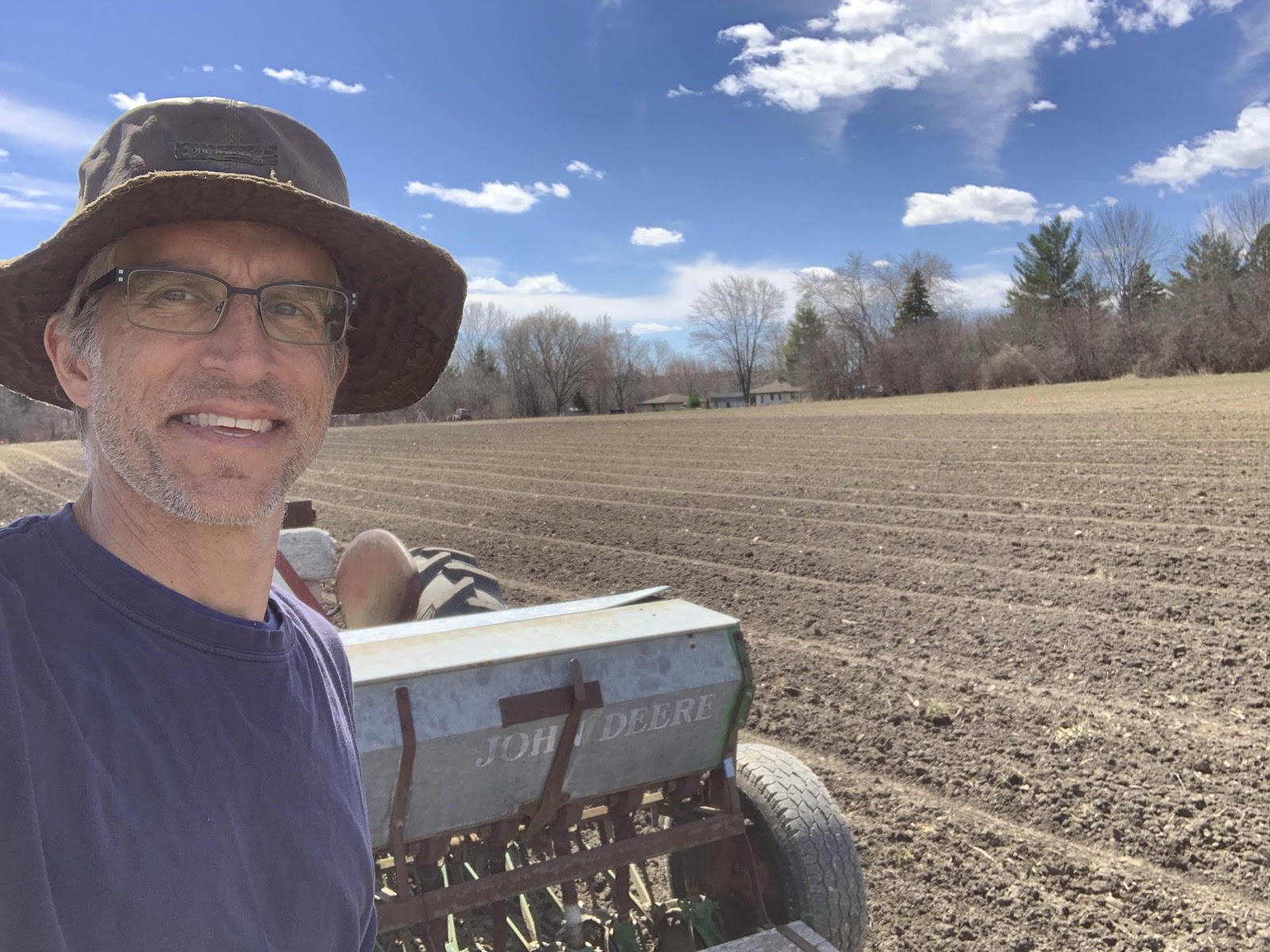
After planting the Marquis and the small plots for growing out seed, I vacuumed out the wheat seed and filled up the hopper with oats and peas.  I also added some split peas that a supplier was throwing out (all organic btw).  Set the rate to notch 29 and made a few passes on the perimeter of the wheat planting.  I hope to get a summer cover crop in the entire field soon.  But I will have to wait for the wet areas to dry up first.

So the Marquis just went parallel to the winter planting, towards the East.  I basically planted until the slope of the hill got into wetter ground.  This ground was also weedier, because I could not work it well last year.  I stopped at around 95 lbs of seed, which turned out to be 86' of width.  86' x 354.5' = .7 acre.  I was using notch 27, and the planting rate calculates out to 135 lbs/acre.  I would have preferred a little more, around 150/acre.

The Haynes Bluestem, looking west.  The winter wheat is off to the right.

Notch 27 for the Marquis resulted in 135 lbs/acre.


It was 2017 Marquis seed.  I sold every bushed from the 2018 harvest!

I got the tractor stuck after working up the seed bed.  I messed around with some stones and boards, but could not get it to budge.  So I left it for a few hours while I went to plant with the 330.  Later in the day I went back and got it out with the help of a neighbor.  He pulled the drag out of the way with his small utility tractor.  Ultimately, we wrapped a chain around the left tire, attached the chain to a tree, and backed it up until we found solid ground.  What a mess--this is the third time in a year that I've gotten the tractor seriously stuck in this field!

Thursday, July 5, 2018

One More Flint planting

It's still terribly hot and humid.  It's been like this for a few days.  Due to the rain and moisture, the mosquitoes are as bad as they get!  However, I've managed to get out every day and the garden is mostly under control.  The main issue is an extraordinary bloom of purslane.  Even though Mother Earth News says it's a great source of nutrition, for me it's a nasty nasty weed.  And it really took hold this year!

Anyhow, I had wanted to put more flint corn in the West end, but that area is so wet that it is still not worked up yet.  So I stuck a little more flint on the high ground.  It's on ground that had sweet corn last year, which is not a very good idea.  But I'd like to have more corn at harvest time, so it will have to do.  This planting will be very interesting, since the rain I was expecting today never came.  There is dry weather forecast for a week or more now.

Four rows of flint, about 30' long I'd say.  In the Southeast corner of the garden.

Not sure why these onions matured so early.  The two other varieties are still growing strong, but these guys are telling me they need to be dug up.

The Marquis field on Newman Rd looks good.  Great, actually, which is nice since the rest of that field has been such a challenge.

Here is the Newman field looking south from the Marquis planting.  The field is still (STILL!) very wet, but it should dry out next week.  I'll finally get to finish discing it, three months after I started.

Wednesday, May 2, 2018

Big fields up

The two spring wheat fields have been slow to germinate, but now they are showing good growth.  They were planted on a Tuesday and Wednesday, April 10 & 11.

The Windhaven field.
A railroad maintenance truck decided to get stuck in the field.  I don't think it will bother much.  They were working on the tracks behind the field and decided to get off using Kathy's drive.

The Newman Field.

There are still at least 6 acres on Newman that need to be disced.  Here I planted the tractor pretty good.  I came back a couple days later and managed to get it out.  Although the field is not really a low field, it sure is holding it's moisture.  I hate that all that poorly-buried sod is getting a chance to grow.  Hopefully I will get it under control soon and I can get a summer cover crop planted.

Wednesday, April 11, 2018

Spring Wheat Planting

Spring 2018 was setting up differently than last year.  There was less moisture in the ground, although weather was cold.  When it did rain, it did not rain much.  (or snow, either)  So I could see an early planting window was possible.  I got out yesterday, and i was not disappointed!

Last year's planting was April 24-25.  It's nice to get in a full two weeks earlier.  Spring wheat does better the earlier it goes in.

The Windhaven field was basically perfect.  I disced it before noon, and it got some sun before I disced it again.  After that it was perfect.  I had two flat tires with the 330, which was a pain, but I got everything planted by Wednesday morning (today).  If things had gone better I would have dragged the field after planting, but I just picked up and ran to the Newman field.

Windhaven field.  This is about 2.3 acres.  I had the drill on notch 27 to start, then went to 26, and finished on 27.  Seven bags total of Red Fife.  152 lbs per acre.  This is exactly what I wanted!


The Newman field was very roughly plowed and the first pass with the disc was pretty miserable going.  I spent about two hours working up one acre for the Marquis.   Some spots probably got six passes with the disc/drag combo.  There are clumps of quackgrass but overall I was pretty happy.  There are close to 4 bags of Marquis seed in this field of around 1.15 acres.  Hopefully this is enough to compete with the weeds.

This is how I look on the 330 pulling the drill.  I ran the drill on notch 27, which may be heavier than what I want.  I put about 4 bags onto this plot.  This works out to 166 lbs/acre.  A tad heavy, but I think I need it to crowd out the old hay that is sure to grow up with the crop.

This is how the Marquis looked when finished.  

The remaining 6 or so acres of the Newman field will have to be disced and planted to a summer cover crop.  However, rain is coming so I won't be back for a couple of weeks.  I want to plant oats and peas, and maybe hay some of it.  The primary goal is to prepare the field for the Vavilov Turkey Red and Wisconsin No. 2, for September planting.  This field is only a mile from my house, which I really appreciate.  It's also surrounded by trees and houses on four sides, completely protecting it from pesticide and herbicide drift.  That will make the wheat coming off this field very unusual.  Most organic wheat sufferers from chemical contamination due to drift, regardless of certification.  It will be very interesting to get the wheat tested after harvest.

Sunday, July 30, 2017

Hy 38 Marquis Harvest

The Marquis harvest on Hy 38 went very smoothly.  Moisture was never a problem--it was testing in the 12's on the very first pass.  By the time I was cleaning and bagging it a few days later, it was 11.2% mc.  I wish they all went this well!  The below picture is the only evidence I have of the harvest.  My phone was causing trouble that day.  The entire field took 2.1 hrs of engine time on the tractor.  The yield was poor.  After cleaning, the tally was 48 bags, exactly 20 bu/acre.


This is what the field looked like the next day.

Wednesday, June 14, 2017

Heads Up

The spring wheat in the test plot looks great!

The Java is just starting to head out.

The Haynes Bluestem is further along.  Most of this was planted April 19, a little less than two months ago.

Closeup of the Haynes Bluestem.

The Marquis, planted on April 23, is not showing any seed heads yet.

The Marquis (left) and Red Fife on Hy 38 are nowhere near as far along as the stuff in my garden.  This was planted April 24 and 25, about the same time.

The Windhaven field is starting to sprout thistles.


I cut the Red Clover on Spring Street June 9.  The sickle bar worked well but had trouble where the stems were real thick.  Although drying conditions were nearly perfect, the hay still came off a bit wet.  Ron & I baled on the 12th and 13th.


Tuesday, April 25, 2017

Red Fife and Marquis planting

April 23-25 presented a small window for planting.  The hy. 38 field would not be ready on its own, but with some extra help I might just get the wheat planted before rain resumes on the 26th.

This bean field only needed some digging and dragging to prepare a seed bed.  To hurry the drying along, I dug it very rough on the first pass and let it sit in the sun.  This broke open the crust and let the moisture evaporate.  


On April 24 I drilled in 2 acres of Marquis.  After counting and calculating it came out to 187 pounds/acre.  I was aiming for 150, so this was a little rich.

On April 25 I put in 5 acres of Red Fife.  The drill was still dumping more than I wanted and I had to really skimp to cover the last 1/2 acre.  It came out to 160 pounds per acre.  I did the first 3.5 acres at notch 27, and then went down to notch 20 to cover the ground as the seed ran out.  Every last grain of Red Fife went into the ground!

I used the 330 for drilling and a final drag of the field.  The drag I used was very stiff and it was hard to make it work well.  The 330, with it's new thermostat and temperature gauge, ran amazingly!


Wednesday, April 19, 2017

Spring Wheat Test Plot

I put the 2017 Spring planting to bed in the test plot today.  What a relief!  The long wet wait this year has been agonizing.  Although I am still a week or two away from the commercial plantings, there was a dry enough patch in the garden to get this important planting in today.

There are two new varieties, both extremely old.  Red May and Java are just about the oldest varieties of wheat that were grown historically in Wisconsin.  Red May is actually a winter wheat, but I planted it in the Spring to get a jump on growing it out.  I will harvest it in August, then turn around and plant it again in September.  This will save me a year on growing it out.

There are some other winter varieties that I received recently from the USDA, but I'm fast tracking the Red May because I'm anxious to have enough to taste.  The other varieties I'm more interested in for comparison and morphological observation.


Here is the Haynes Bluestem that I first grew out in 2016.  I am really excited to see how it does this year.  Last year's planting was late in the season.

Here is the Prelude, also in it's second year on the farm.

Here is how the plot looks.  From North to South, each variety is in a 4-row block.  The northernmost block (not pictured, because I planted in later) is a mix of the 2016 varieties that I found after winnowing the chaff.  I hope to grab a few blue stems out of this stand and therefore add to my stock of bluestem seed this year.  Haynes Bluestem really does have blue stems, and it should be easy to spot.  The other seed should be Turkey, Pedigree No. 2, Bacska, and Prelude.

Here is one of the stands of Turkey from last Fall's planting.  It looks beautiful!  To the left you can see a few blades of Bacska that survived the Fall die-off.  If I get some seed out of here I will propagate it with Spring plantings from now on.  I believe that the Bacska died due the topsy-turvy weather last Fall.  This variety seems to require a very gradual cooling and a reliable snow cover to survive winter.  Since it was once a successful winter crop in Wisconsin, I suspect this crop failure is a sign of a changing climate in our region.  

Testing the digger in the field on Hy 38.  It's too wet to work the whole field but I found a dry spot to try out this digger and drag, which are both new to me.  This is a soybean field I am leasing and all of the Red Fife and Marquis will be planted here.  If the rain holds off and the sun keeps coming out, I hope to plant 7-8 acres next week.


Monday, August 1, 2016

Marquis Harvest

The Marquis harvest started on July 28, but the moisture level was coming out pretty high, around 17%.  When it did not dry down, we stopped and put all the grain into my small grain dryer.


By August 1 it was reliably coming out at 13-14%, close enough so that aeration could be counted on to finish it off.  So Ron got the field cleaned up and the Marquis was safely in the shed after a couple of hours.  After cleaning and bagging, this 2 acre field produced about 34 bushels of wheat.  I intend to plant thicker next time--we drilled in 2 bushels per acre, and from looking at the stand it appeared there was room for more plants.  Try 2 1/2 next time for sure.  This was also a very late planting and I expect this reduced the harvest as well.