Monday, July 2, 2018

Turkey Red Differences

It's very impressive to observe the Vavilov Turkey Red, Ehmke Turkey Red, and Wisconsin No. 2 in the Spring Street field.  They all share the same 2 acre parcel.  The Ehmke surrounds the two smaller plots, which are both in their third year of being grown out from USDA samples.

Seeing the Vavilov Turkey Red, which is basically the USDA's archival example of Turkey Red, diverging from the Ehmke so significantly makes me feel even more strongly that Ehmke (and Heartland, and Stephens Turkey) are not representative of 19th Century Turkey.  My hypothesis is that Wisconsin No. 2, being the oldest extant collection of Turkey (it was collected in 1905 and improved by simple selection), is the most authentic.  Now I just want to bake with it!

The Ehmke Turkey on Spring Street.  Although it looks great in the photo, in reality there is a lot of stuff knocked down.  The downpours have been pretty hard on the field, although it does tend to get up when it dries out.  We had one event of 1.25" in little more than an hour.  This particular field still had standing water on July 2.

All the low areas of Ehmke are pretty well down.  But it's still growing and looks healthy.  Ron is confident we can get it in the combine.

Here is where it gets interesting.  Both the Wisconsin Pedigree No. 2 and Vavilov Turkey are still green.  I'd say they are both 10 days behind the Ehmke.  To me, this is yet more evidence that Ehmke is not "the real Turkey."

More knocked down Ehmke!

Here is Pedigree No. 2 in the pizza plot at home.  It's starting to turn and show the red stems again!

The Wisconsin Pedigree oats in the test plot.

Haynes Bluestem.

This is the Haynes up close.

The Haynes stems are faintly bluish.

The Java was knocked down by the rain, unlike the Haynes which is fully standing up.

Thursday, June 21, 2018

Popcorn, Hay, and Rain

Popcorn on June 14

Cutting hay in June

Cassie is moving all the hay for me this year.  She stands so much better than Sebastian!

My first attempt at a Romanian haystack.  The hay is not doing well under the tarp this year, since there is no time to dry with all the rain.  Hopefully this will work better.

Standing water in the garden has been a regular feature this May and June.  

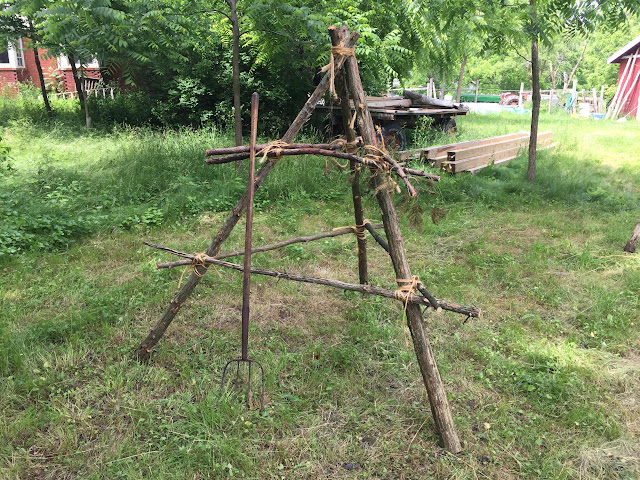
Here's my tripod drying rack.

Tripod covered in hay.

This was the biggest event--about 5 inches of rain over a week or so in mid-June.  On either side of this event was cloudy, wet weather.

Stacking hay.

Saturday, June 2, 2018

Test Plot Update

After a cold, late, wet Spring, things are greening up quickly in the test plot.  Here is a snapshot from June 2.

This is the Java, on the South end of the plot.  The row in front is ordinary Red Fife, from my main stock.

Here is the Haynes Bluestem.

On the right: Montana No. 36, Nebraska No. 60 (dead), Nebraska No. 6
On the left:  Wisconsin No. 2 (WN2), Early Noe, Red May (from 2017 Spring planting, dead)
The Early Noe is short and can't be seen.


Rows 1, 2, and 3 of the plot.

The Haynes Bluestem.

Spring test plot.  

Tuesday, May 8, 2018

Corn planted

I put in four ~40 foot rows of Who Gets Kissed? OP sweet corn.  This is ground where winter wheat and potatoes grew last year.  I'm using the plot in a much more contoured way this year.  The rows are still N-S, but I'm leaving the low areas for later plantings.

The West end, as usual, is the hardest area.  I hope to get way over there this year and dig out the grass. Then I can put in a nice hay and just stay out of there.  The problem is that it stays wet, and if it stays wet, it can't be worked very well.  During the time that it's wet, the sod keeps growing.  Catch 22.

Elliot thinks the extremely rare wheat in the test plot is his own personal cat grass.

The flock loves tearing into the compost pile!

Wednesday, May 2, 2018

Big fields up

The two spring wheat fields have been slow to germinate, but now they are showing good growth.  They were planted on a Tuesday and Wednesday, April 10 & 11.

The Windhaven field.
A railroad maintenance truck decided to get stuck in the field.  I don't think it will bother much.  They were working on the tracks behind the field and decided to get off using Kathy's drive.

The Newman Field.

There are still at least 6 acres on Newman that need to be disced.  Here I planted the tractor pretty good.  I came back a couple days later and managed to get it out.  Although the field is not really a low field, it sure is holding it's moisture.  I hate that all that poorly-buried sod is getting a chance to grow.  Hopefully I will get it under control soon and I can get a summer cover crop planted.

Thursday, April 26, 2018

Onions and Cilantro planted

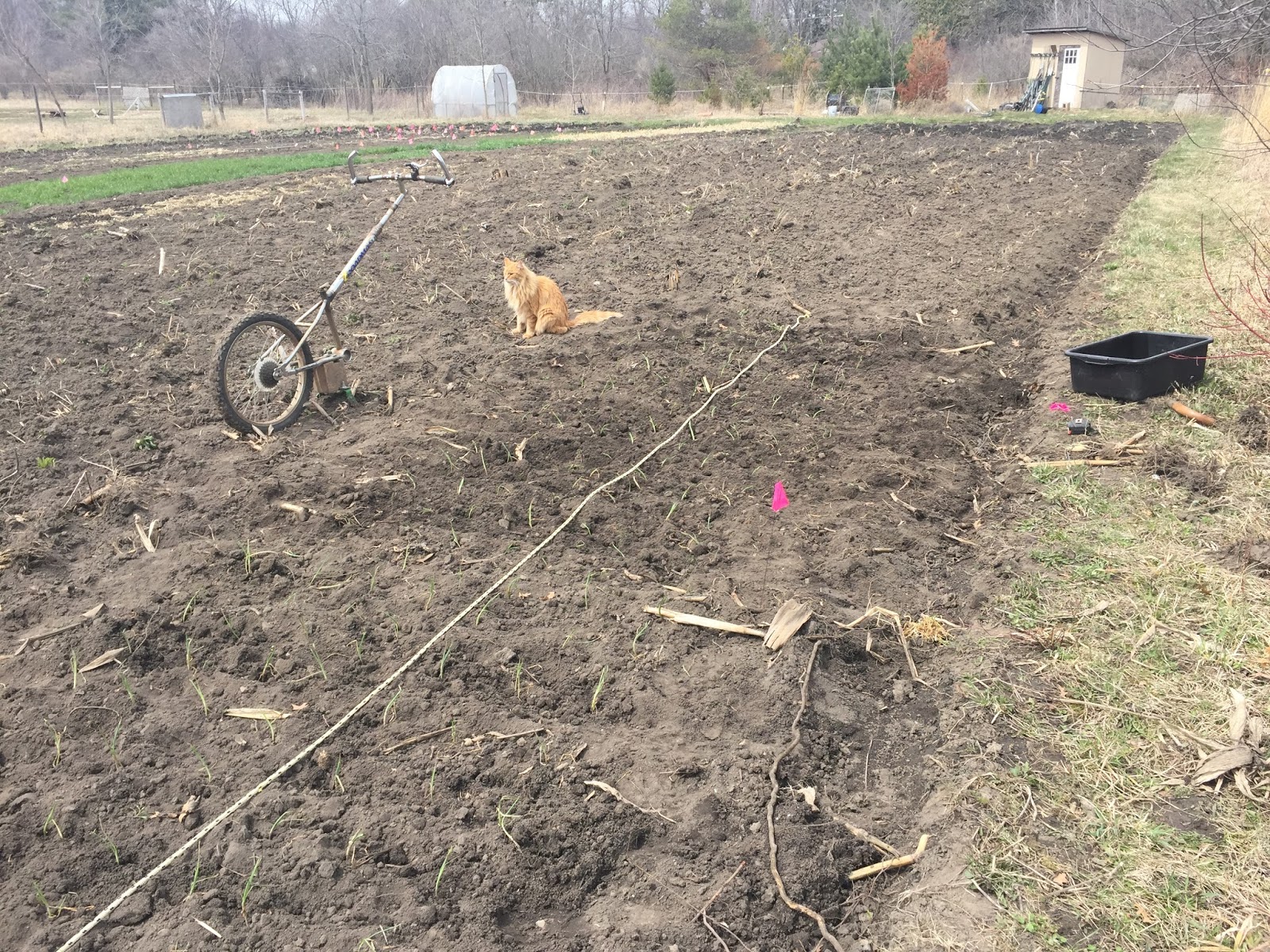
I planted three bunches of onions, in the far Southeast corner of the garden.  I had to work it up by hand as there are still too many wet spots to get the team in yet.  This is around 300 onions and it will be more than enough to feed me next winter.


The spring planted Wisconsin No 2 is not showing very much color.  I only planted it to get a picture of the color that some heritage variety wheat showed, but so far the Java and Haynes Bluestem have shown color much more dramatically.

This is the Haynes Blustem, coming up nicely.  Like most of the spring wheat in the test plot, it's a month old today.

Sunday, April 22, 2018

Spring Wheat Notes

I have been checking the test plot at least twice a day recently.  I'm interested in the appearance of the wheat plants after germination.  Here are my notes from today.  It's been over a week since the first Java wheat emerged.

Winter wheat test plot:

  • Beloturka 100% dead
  • Kharkof  100% dead
  • Red May from 2017 100% dead
  • Nebraska No 60 100% dead
Everything except the Red May is something of a puzzle.  The Red May is no unexpected because it grew so poorly as a Spring wheat, and I have doubts about the seed's authenticity.  But the other wheats are bona fide winter crops, and it's strange that they died.

Spring wheat test plot:

  • Haynes Bluestem is basically all up, and it looks great.  There has been some nice red coloring on some of the stems.
  • Dakota is all up, and it's all green.  This is supposedly a selection of bluestem
  • Early Red Fife is up, with some red tips.
  • Purplestraw is a little behind the other plantings.  It's just starting to emerge.
  • The Red Fife planted as a control next to the Java is all up now.
Today was a beautiful day, sunshine and clear.  The soil is still quite wet but the standing water on the farm has basically disappeared.