Tuesday, May 16, 2017

Bacska

The Bacska mystery is deepening.  After the die-off in November of 2016, a few plants remained in both the Aussie and USDA test plots.  Once they started to grow in the Spring, I cleaned out the weeds around them with a hoe a few times.

By May I could get a feel for what was going on, and it was clear that much more of the USDA Bacska survived.  I will do a count soon, but it's on the order of 3-5 times greater survival in the USDA seed stock versus the Aussie.  Weird!  I have no idea why the line preserved by the USDA is doing better than the one preserved by the Australian Winter Cereals Collection.

The two test plots of Bacska.  The left side is the USDA line of Bacska, and the right side is Aussie.

Sunday, May 14, 2017

Windhaven Field

My friend Kathy has a two-acre hayfield that has fallen into disuse which we plan to use for a wheat crop.  The field is extremely rutted, so I began by discing the entire field once.  This helped a little bit.

I plan to keep the field bare until most of the weeds are dug up and dried out, and then put a cover crop of oats and peas on.  I will probably use it for spring wheat in 2018.


This is Brian's 3-16 plow attached to my Case 1494, and 85 hp diesel unit I found on craigslist.  This combination ran well, although I occasionally ran out of traction in wet areas.  Like everything else in our area, this field still had some wet spots.

We did make some straight furrows, which I'm very happy about!

The soil was turned over well in most places.  Especially towards the end, when the bottoms were mostly scoured, things ran well.


Tuesday, May 9, 2017

Plowing

I have some of the best soil preparation to date this year, despite the cold wet spring which just does not help.  With the normal north-south field work pattern (or any other pattern), the plow is always going through both wet and dry soil.  However, in the more cooperative parts of the garden the plow is working just amazing.  I also have a new version of the disc which can go over plowed ground and make a nice seed bed.

I stuck the basket roller from my old cultimulcher project onto the back of the brinly disc and I really like the results.  It's super stable and easy for the team to pull.  I still think a second disc gang would be best, but until I find one this is a great solution.

In good soil the plow is super-stable and really turns the soil over.  It goes about 4" deep.


Here is the danish digger being pulled.  Sebastian loves to reach over and grab a bite of the super-rare wheat growing right next to him, oblivious to my objections.

Here is the renovated section of pasture, disced and seeded.

Onions went in on May 9.


Tuesday, April 25, 2017

Garden

One row of fingerlings went in on 4/25.

This is how the Haynes Bluestem planted on 4/18 looked on 4/25.

Some squash are coming out of the compost pile by themselves.  I will let a couple of these keep going.

As of late April the donkeys are coming up to the front yard for grazing.

Red Fife and Marquis planting

April 23-25 presented a small window for planting.  The hy. 38 field would not be ready on its own, but with some extra help I might just get the wheat planted before rain resumes on the 26th.

This bean field only needed some digging and dragging to prepare a seed bed.  To hurry the drying along, I dug it very rough on the first pass and let it sit in the sun.  This broke open the crust and let the moisture evaporate.  


On April 24 I drilled in 2 acres of Marquis.  After counting and calculating it came out to 187 pounds/acre.  I was aiming for 150, so this was a little rich.

On April 25 I put in 5 acres of Red Fife.  The drill was still dumping more than I wanted and I had to really skimp to cover the last 1/2 acre.  It came out to 160 pounds per acre.  I did the first 3.5 acres at notch 27, and then went down to notch 20 to cover the ground as the seed ran out.  Every last grain of Red Fife went into the ground!

I used the 330 for drilling and a final drag of the field.  The drag I used was very stiff and it was hard to make it work well.  The 330, with it's new thermostat and temperature gauge, ran amazingly!


Wednesday, April 19, 2017

Spring Wheat Test Plot

I put the 2017 Spring planting to bed in the test plot today.  What a relief!  The long wet wait this year has been agonizing.  Although I am still a week or two away from the commercial plantings, there was a dry enough patch in the garden to get this important planting in today.

There are two new varieties, both extremely old.  Red May and Java are just about the oldest varieties of wheat that were grown historically in Wisconsin.  Red May is actually a winter wheat, but I planted it in the Spring to get a jump on growing it out.  I will harvest it in August, then turn around and plant it again in September.  This will save me a year on growing it out.

There are some other winter varieties that I received recently from the USDA, but I'm fast tracking the Red May because I'm anxious to have enough to taste.  The other varieties I'm more interested in for comparison and morphological observation.


Here is the Haynes Bluestem that I first grew out in 2016.  I am really excited to see how it does this year.  Last year's planting was late in the season.

Here is the Prelude, also in it's second year on the farm.

Here is how the plot looks.  From North to South, each variety is in a 4-row block.  The northernmost block (not pictured, because I planted in later) is a mix of the 2016 varieties that I found after winnowing the chaff.  I hope to grab a few blue stems out of this stand and therefore add to my stock of bluestem seed this year.  Haynes Bluestem really does have blue stems, and it should be easy to spot.  The other seed should be Turkey, Pedigree No. 2, Bacska, and Prelude.

Here is one of the stands of Turkey from last Fall's planting.  It looks beautiful!  To the left you can see a few blades of Bacska that survived the Fall die-off.  If I get some seed out of here I will propagate it with Spring plantings from now on.  I believe that the Bacska died due the topsy-turvy weather last Fall.  This variety seems to require a very gradual cooling and a reliable snow cover to survive winter.  Since it was once a successful winter crop in Wisconsin, I suspect this crop failure is a sign of a changing climate in our region.  

Testing the digger in the field on Hy 38.  It's too wet to work the whole field but I found a dry spot to try out this digger and drag, which are both new to me.  This is a soybean field I am leasing and all of the Red Fife and Marquis will be planted here.  If the rain holds off and the sun keeps coming out, I hope to plant 7-8 acres next week.


Friday, April 14, 2017

Waiting for the rain to stop

Things were soaking wet well into late April this year.  Although I can usually count on planting peas and greens in the garden during the first week of April, this year it took until mid-May.


More archived wheat seed from the USDA for testing!

I borrowed this JD 4020 from Brian to plant 7 acres of Spring wheat.

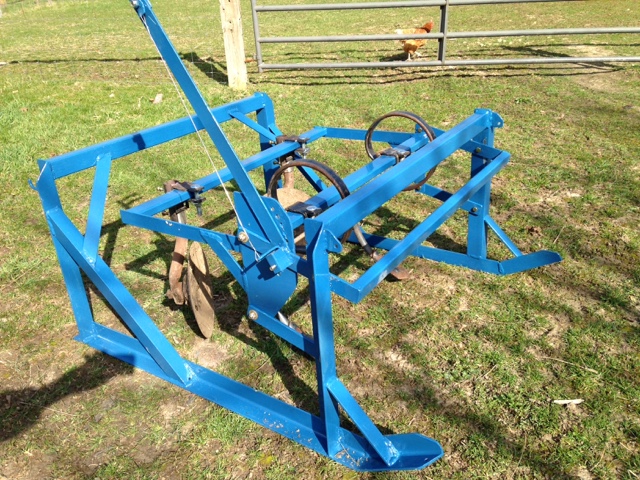
This welding project came out of the shop over the winter.  I hope to use it for hilling potatoes and making raised beds.

Poor things had a long season of mud and cold in 2017.